
College Financial Aid Advisors Scholarship

Blog

What Families Forget After They Commit to College

What Families Forget After They Commit to College

With the end of the school year coming to a close and big decisions made, many are ready to detach and enjoy the summer before things start changing. I completely get it too, because after months of applications, financial aid forms, acceptance letters, and decision-making, finally committing to a college brings a huge sense of relief.  It’s an exciting milestone worth celebrating. However there are a few things that can slip through the cracks over the summer if you aren’t careful. Here’s what families forget after they commit to college.  What Families Forget After They Commit to College One of the biggest misconceptions families have is believing that once a student commits, everything is officially “done.” In reality, committing to a college is less of an ending and more of a transition into the next phase of the process.  I know that this time of year through the summer is busy. Seniors are graduating, celebrating, traveling, working summer jobs, and trying to enjoy their final months before college begins. Parents are juggling calendars, paperwork, and preparations for a major life transition. It’s all completely understandable. What’s important to remember though is that colleges continue communicating with students all summer long, and missing small requests or deadlines can sometimes create unnecessary stress later. Trust me, you don’t want to open up your email on a whim at the end of July and realize you missed an important housing form deadline or registration due date. Continue to Check Student Portals and Emails Therefore it is important to continue checking emails and student portals throughout the summer. Many should be used to this routine already as you should have been checking in weekly for financial aid applications. This is just a continuation of that process.  Check in weekly to ensure there are no messages or requests about financial aid, billing and payment deadlines, housing, orientation, class registration, health and immunization requirements, or course placement or advising information. As you can see, there is still quite a bit of things that are going on behind the scenes in preparation for you to come in the fall and you don’t want to miss anything.  Keep Track of Deadlines  Many families are surprised by how many separate items and deadlines appear over the summer. There is no need to panic though. Just stay organized and continue to check in and respond to anything that comes in.   Summer has a way of making people feel like there’s plenty of time, until suddenly there isn’t. Many colleges have separate deadlines for: Housing deposits and roommate selection Orientation sign-ups Tuition payment plans Health records and immunization forms Placement testing Loan paperwork The families who stay organized now are usually the ones who avoid last-minute stress later. I suggest marking any and all deadlines on a calendar that will get checked regularly. If it is a digital calendar set up due date notifications, that way you can stay on top of every deadline.  Remember to also save copies of submitted forms and confirmations. If you followed earlier advice when you were applying to schools and Financial aid, you should already have an organized folder (either a physical file folder or digital one on your computer) that you can save these to.   These small steps help prevent important items from getting buried during a busy summer. Enjoy the Summer This season should absolutely be exciting. Graduation celebrations, family time, vacations, and preparing for college are all part of this transition, and students deserve to enjoy it.  The key is to stay lightly engaged with the process throughout the summer to ensure there are no unexpected surprises waiting in August. The students and families who stay organized now are usually the ones who head into the fall feeling the most confident and prepared!  More about Jodi and College Financial Aid Advisors Jodi is a FAFSA financial advisor who helps with the financial aid process to help families of college students maximize their financial aid. From completing the FAFSA and completing the CSS Profile to reviewing the SAR, responding to requests for verification, comparing financial aid offers and understanding student loan options, Jodi is a fantastic resource when it comes to student financial aid. Schedule a 15 Minute Power Chat to learn more about finding ways to pay for college.


Your Financial Aid Isn’t Final Yet—Here’s Why

Your Financial Aid Isn’t Final Yet—Here’s Why

Many people are shocked to find out that financial aid isn’t final yet! Yes, it can still change even after school acceptance. This happens for a variety of reasons, but it can be confusing and disheartening, especially if you weren’t aware this could happen.  Here’s a look at some of the reasons why financial aid might change and what to do if it happens to you.  Financial aid offices are managing thousands of student files at once, and many colleges continue finalizing awards long after students commit. Sometimes schools are simply finishing their review process. Other times, additional information is needed before aid can officially be finalized.  It’s also important to remember that financial aid is based on estimated costs. Therefore, changes in financial circumstances can lead to adjustments, either by the school or through an appeal by you. Why Financial Aid Can Still Change It is still possible to receive verification requests for financial aid, whether due to missing or incomplete documents, corrections to FAFSA or CSS Profile information, new tax or income information, or even scholarship adjustments or other scholarships being awarded. All of these can result in financial aid changes, which are sometimes very small, and sometimes have a bigger impact. Other times, it might simply be clarification they are seeking before finalizing your account. While it can feel stressful to see updates happening this late in the process, it does not automatically mean something is wrong. Sometimes these updates or verification requests are the result of bigger items directly affecting aid. For instance, if a student receives external funding, a school will adjust their aid package as that particular student would no longer need as much funding. In other cases, a student may change their enrollment status. If a student decides to attend school part-time instead of full-time, that would change the amount of tuition and expenses needed and as a result, aid eligibility. Additionally, some scholarships and grants have specific requirements, such as a certain GPA. Failing to meet the scholarship requirements will result in that funding being reduced or cancelled. What Families Should Do Right Now Even though the college decision may already be made, students should still check their email and student portal. If something does change or needs verified, you will likely see it come through your portal first. Continue to check portals and emails regularly throughout the spring and summer. Once a week is ideal.  It is also important to note that you might need to officially accept, or decline, your financial aid, whether grants, loans, or work-study offers.  You can typically do this in your student portal. Failure to complete this step might cause aid to not be applied correctly. If you do see a request for more information or a change  come through, it is important not to panic! Respond promptly to anything the financial aid office requests. Delays can slow down timelines and disbursements. The faster documents are submitted and questions are answered, the smoother the process tends to be.  Seeing a revised award letter or receiving another request for information can immediately make families nervous.  However, updates are often part of the normal review process. In most cases, colleges are simply ensuring they have accurate information before finalizing everything for the school year. Lastly, and most importantly, if you receive something you don’t understand, ask questions! Your financial aid office will help you if you unsure of what something means or what is needed.  More about Jodi and College Financial Aid Advisors Jodi is a FAFSA financial advisor who helps with the financial aid process to help families of college students maximize their financial aid. From completing the FAFSA and completing the CSS Profile to reviewing the SAR, responding to requests for verification, comparing financial aid offers and understanding student loan options, Jodi is a fantastic resource when it comes to student financial aid. Schedule a 15 Minute Power Chat to learn more about finding ways to pay for college.

You Committed—Here’s What Actually Happens Next After Committing To a College

You Committed—Here’s What Actually Happens Next After Committing To a College

You did it! Congratulations! You made your decision and said “yes” to a college offer, and that’s a big deal! I hope you’ve taken a moment to celebrate this milestone. As a financial aid advisor, I’ve seen this moment come with a mix of joy, relief, and a dozen new questions. This is completely normal, and I’m here to help you through what comes next. The truth is, committing to a college isn’t the final step. It’s just the transition into a new phase of the process.  Now that you’re committed and told the college that you’re attending, the fun begins as you start preparing for your big move later this summer! Here’s what actually happens after committing and what you need to do.  From Applicant to Student  The past few months you’ve consistently been referred to as an applicant, but once you commit to a school, you are now an incoming student. This exciting change is more than just semantics, it means that things are happening behind the scenes. You’ll begin to access a student portal or see updates with the portal you’ve been using. This will continue to be your main communication hub along with your school email. Colleges will begin sending important information about housing, orientation, meal plans, tuition bills, and financial aid to your school email instead of your personal email. Keep in mind that each school handles things a little differently, so communication may come in waves or all at once. The key is simply to keep an eye on  your email and the student portal so nothing is missed. I suggest checking your portal and email weekly, and mark any deadlines you know of on a calendar. Just like when you were preparing to apply for colleges and financial aid, being proactive and organized now can save you stress later. Review The Financial Pieces    Once you commit to a school, the financial part of the equation becomes more real and concrete. Take a close look at your financial aid award. It likely includes a mix of grants, scholarships, loans, and work-study. Decide what to accept and complete any follow-up steps that you can now, like signing any documentation for loans. You will also be expected to complete entrance exam counseling for first-time loan borrowers before any money is disbursed. This counseling details your obligations and expectations as a loan borrower.  Colleges typically send billing statements over the summer, and that’s when you’ll see exactly how your financial aid is applied and what your remaining balance looks like. If anything about the bill feels different than expected, don’t ignore it. This is the time to ask questions and make sure everything is accurate. If you have questions, or if something doesn’t look right, your financial aid office is here for you, and so am I!  Have a Plan in Place To Pay the Balance Even with financial aid, many students still have a remaining balance. Colleges usually offer payment plans that spread this out over the semester or year if you need additional help breaking things up over time. Be sure that you know when tuition is due as well as your payment schedule. Don’t forget to also review your scholarships or extra savings you plan to use to pay.  Remaining Details and Requirements If you’re living on campus, watch for housing application deadlines. Registering for orientation is also key, as this is your first real step into college life and often required before registering for classes. It’s important to stay on top of deadlines and sign up dates for everything leading up to move-in, so watch your portal announcements carefully.  You will likely need to submit final documents upon graduation from high school, such as your final high school transcripts, possibly along with immunization records or placement test scores. These items can hold up your registration if not submitted on time. So, it’s important to know up front what is needed from you and when it is needed or expected by. Staying organized, as always, is crucial at each stage of this process.   Now Get Excited!  This time between commitment and move-in day is a season of preparation and transition for both students and families. You don’t need to have all the answers today. All you need to do right now is stay engaged, organized, and respond to any requests or deadlines as they come in.  Committing to a college is a major decision; one that reflects careful thought, planning, and a lot of hard work. And you did it!  As you transition to this new and exciting chapter in  life, you don’t have to navigate it alone. Your college’s staff, your financial advisor (like me), orientation leaders, professors, and support offices, and of course, your loved ones, are all cheering you on.  Congratulations on all that lies ahead! More about Jodi and College Financial Aid Advisors Jodi is a FAFSA financial advisor who helps with the financial aid process to help families of college students maximize their financial aid. From completing the FAFSA and completing the CSS Profile to reviewing the SAR, responding to requests for verification, comparing financial aid offers and understanding student loan options, Jodi is a fantastic resource when it comes to student financial aid. Schedule a 15 Minute Power Chat to learn more about finding ways to pay for college.
Decision Day Is Coming: How to Make a Smart College Choice by May 1

Decision Day Is Coming: How to Make a Smart College Choice by May 1

Decision day is around the corner! May 1st is National College Decision Day, which is the deadline most colleges expect students to officially commit by submitting an enrollment deposit. With May 1st approaching rapidly, many students are taking this time to make their final selection. If you are feeling the pressure to make the “right” decision, here’s how to make a smart college choice by May 1st and feel good about it. How to Make a Smart College Choice by May 1 Know What You Are Committing To Committing to a school means you’re ready to invest your time, energy, and money there. You’re not just choosing a campus; you’re choosing a community, a support system, and a place to grow, learn, and live for the next four years.  Before you officially commit, make sure you’ve looked at all the factors. Finances are a major component in this decision, so make sure you consider your entire financial aid package. You should be able to answer questions like these: What’s a grant vs. a loan? Which aid is renewable? What is the total cost of attendance, not just tuition?  And the most important question: what is your net cost, aka the money you are responsible for paying out of pocket?  Also consider the academic and social benefits from the school. What is the job rate after graduation in your field? Which school offers the best academic program in my field of study? What other opportunities are available? How did the campus feel? Could you be happy there? What activities or campus groups were you excited about? All of these things and more should be taken into consideration, because you want to make sure all the components feel like the right fit. Compare Schools  As you prepare to make this decision, be sure you are comparing the numbers and these other factors of all schools in consideration.  When it comes to financial aid, not all aid packages are created equal. Some schools might offer you more scholarships or grants up front, which appears to be the better option, until you realize they have higher living costs or total cost of attendance, hidden expenses, or fewer scholarships that renew after your first year. I highly suggest making a quick spreadsheet if you haven’t already, or use an online comparison tool. This will help you keep information organized and easily compare schools on your list.  Notify Other Schools  Once you commit to your choice school, take a moment to decline the other offers. It’s good manners, helps free up spots for other students, and avoids unnecessary emails and reminders. It’s the polite thing to do and most schools require a response either way.  Changing Circumstances Saying “yes” and putting down a deposit doesn’t mean you can’t change your mind. Life happens and circumstances can change. Transferring later is possible if necessary, but try to commit based on what you know about your school choices, finances, and how you feel now. That said, those deposits are usually non-refundable, so make sure you’re fairly confident before you submit. Now, Celebrate! Whether you’re headed to a state school, a liberal arts college, a community college, or something else entirely, take a second to breathe and pat yourself on the back. This journey has been a long one, and you made it through. Congratulations!  More about Jodi and College Financial Aid Advisors Jodi is a FAFSA financial advisor who helps with the financial aid process to help families of college students maximize their financial aid. From completing the FAFSA and completing the CSS Profile to reviewing the SAR, responding to requests for verification, comparing financial aid offers and understanding student loan options, Jodi is a fantastic resource when it comes to student financial aid. Schedule a 15 Minute Power Chat to learn more about finding ways to pay for college.

Admitted Student Days: What Families Should Ask About Financial Aid and College Costs

Admitted Student Days: What Families Should Ask About Financial Aid and College Costs

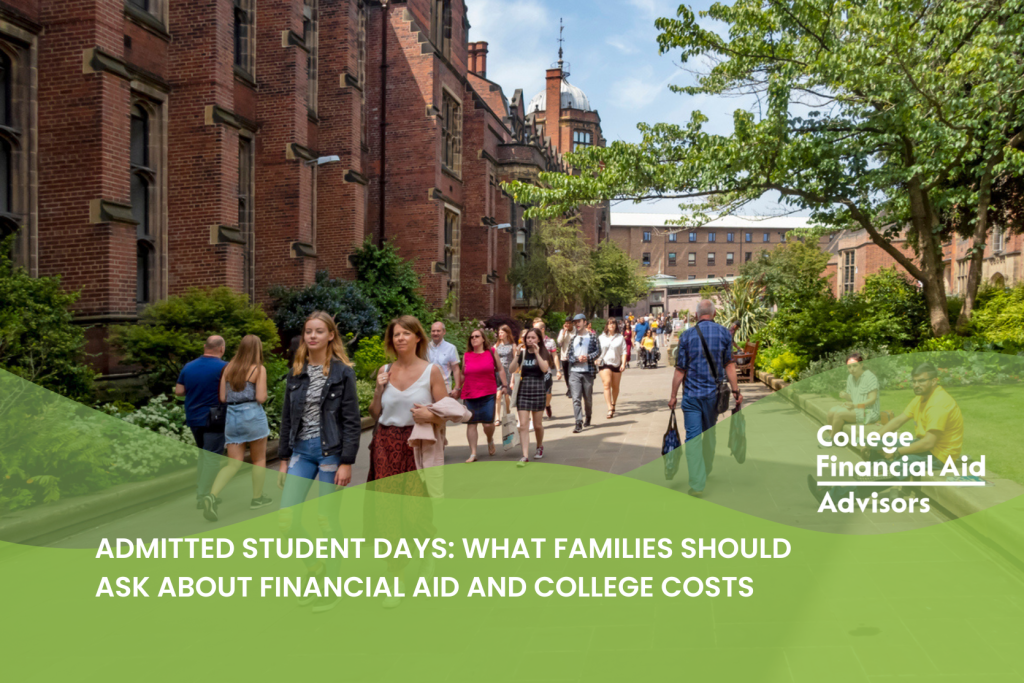
Admitted Student Days are one of the most exciting parts of the college decision process. Students have been accepted, the pressure of applications is behind them, and now they have the opportunity to return to campus and imagine what life could really look like there. These visits are often filled with excitement as students meet future classmates, explore campus, and celebrate this huge milestone. These days are also designed to help families understand the real cost of attending. Here are a few things to consider and questions families should ask about financial aid and college costs. More Than Just a Campus Visit Unlike earlier tours, Admitted Student Days are much more detailed and practical. Students can learn and ask questions about housing options, meal plans, orientation, student activities and groups, academic programs, and course planning.  These visits give students a clearer picture of what their day-to-day life will look like academically and personally. Why Financial Conversations Matter During These Visits While the academic and social experience is important, the financials play a major role in the final decision. A school may feel like the perfect match in every way, but if the cost isn’t realistic, then it’s important to be honest with yourself about that, as it can quickly become a stressful situation. That’s why Admitted Student Days are a valuable opportunity to ask real, practical financial questions. Many colleges offer dedicated financial aid sessions during these events, and they are absolutely worth attending.  What Families Should Ask About Financial Aid and College Costs Before your visit, take time to review the school’s total cost of attendance, your student’s financial aid award, any scholarships or grants offered, and the net cost of attendance. Remember net cost is the amount you are expected to pay, whether through loans, savings, or income, after your grants/scholarships – aka free money – has been applied to the total cost.  As you review your award letter and financial situation, jot down any questions you have so you don’t forget once you are there.  Then, use your time on campus to ask those questions and any others that arise while you are there.  Here are a few questions to consider.  Understanding the True Cost Ask how the college calculates total cost and what expenses families should realistically expect to be responsible for beyond tuition. This includes housing, meals, books, transportation, and personal expenses. Scholarship and Grant Details Clarify whether scholarships are renewable and what is required to keep them. Some awards depend on maintaining a certain GPA or enrollment status. Billing and Payment Timelines Understanding when bills are due and how payments are structured can help families plan ahead. Ask about payment plans and whether the school offers options to spread out costs over time. If you are going to use a payment plan, make sure the payment schedule is realistic for your situation.  Financial Aid Adjustments or Appeals If your financial situation has changed or your award doesn’t reflect your circumstances, this is a good time to ask about an appeal and what that process looks like, what documentation is needed, and the timeline of an appeal.   Keep Your Financial Reality in Mind It’s easy to get swept up in the excitement of these visits, which is completely understandable. This is a major milestone worth celebrating; however, it’s also important to keep your financial reality in mind. Before committing to a school, make sure you clearly understand what your out-of-pocket cost will be each year, how that cost will be covered, and whether the plan is sustainable for all four years.  A college should be a great fit academically, socially AND financially. Finding Clarity Before Making the Final Decision For many students, Admitted Student Days are where the final decision begins to take shape. Sometimes you feel the energy and can picture yourself there, or it might be a conversation with a professor in your desired field, and sometimes, it’s finally understanding and feeling confident about the financial side. These visits give families the opportunity to ask the right questions, gather the right information, and move forward with confidence. Because choosing a college isn’t just about where your student is accepted. It’s about choosing a school that truly works, in every sense of the word. More about Jodi and College Financial Aid Advisors Jodi is a FAFSA financial advisor who helps with the financial aid process to help families of college students maximize their financial aid. From completing the FAFSA and completing the CSS Profile to reviewing the SAR, responding to requests for verification, comparing financial aid offers and understanding student loan options, Jodi is a fantastic resource when it comes to student financial aid. Schedule a 15 Minute Power Chat to learn more about finding ways to pay for college.

How to Read and Understand a Financial Aid Award Letter

Understanding Your Financial Aid Award Letter

Receiving your financial aid letter is a huge milestone in your college journey, but it can also be overwhelming and confusing. Understanding your financial aid award letter and knowing what’s actually free money and how much you are required to pay now, or pay back later, is key to making the right decisions for your future. Here’s how to read and understand a financial aid award letter. Look at the Free Money First: Grants and Scholarships Grants and scholarships are the best parts of your financial aid package because they don’t require repayment. These are the numbers to focus on first. Grants are often based on financial need, while scholarships can be awarded for academic achievement, athletic ability, or other criteria. Be sure to check if any scholarships are renewable, meaning they can continue each year as long as you meet certain criteria.  Money You Have to Pay Back: Loans Loans are the money you borrow to help pay for school, but remember: this is money you’ll have to repay, with interest. There are federal student loans, which often come with lower interest rates and better terms, and private loans, which can vary in cost and typically have higher interest rates. Always be aware of how much you’re borrowing and how it will affect you after graduation. Work-Study Work-study is a great way to earn money while in school, but it’s not free money. These are part-time campus jobs that you can use to cover some of your living expenses or other costs, but remember that you’ll have to work for this money. Therefore you will need to factor in your schedule and if you have the time to make it all work. There are limits on how much you can earn through a work-study program, and your school will set a maximum number of hours per week you can work. It’s still a good opportunity to gain experience and earn money without taking on more debt. Understanding Your Financial Aid Award Letter  While loans, work-study, and grants are the main components of most financial aid packages, your award letter should include other information, like renewability, deadlines, and other eligibility criteria. Ensure that you understand what you’re signing on for and if this funding will help you through your college journey.   As you prepare for college, understanding the world of finances can feel like learning a new language, especially when you start looking at your financial aid award letter. But don’t worry, you’re not alone!  Understanding the differences between grants, loans, and work-study will help you make an informed decision about which offer is best for you. Don’t be afraid to ask questions if you’re unsure about any part of your financial aid letter. Knowing what’s free and what’s not will set you up for success in the future! Take your time to read through all the details, ask questions if you don’t understand something, and make sure you’re clear on how each type of aid works. Paying for college is a big responsibility, and it’s important to know exactly what you’re agreeing to. More about Jodi and College Financial Aid Advisors Jodi is a FAFSA financial advisor who helps with the financial aid process to help families of college students maximize their financial aid. From completing the FAFSA and completing the CSS Profile to reviewing the SAR, responding to requests for verification, comparing financial aid offers and understanding student loan options, Jodi is a fantastic resource when it comes to student financial aid. Schedule a 15 Minute Power Chat to learn more about finding ways to pay for college.

How to Make the Final College Decision With Confidence

How to Make the Final College Decision With Confidence

As May 1st approaches, high school seniors are faced with one of the biggest decisions they’ve had to make – choosing which college to attend. It’s completely normal to feel both excited and overwhelmed. After months of applications, acceptances, and financial aid offers, everything comes down to one choice. Here’s how to make the final college decision with confidence.  Start With the Numbers  Before anything else, take a close look at your financial aid offers. This means going beyond the initial award letter and comparing all the numbers side-by-side. When you do this, the differences can be more significant than they first appear. A school that seems more “affordable” upfront may actually cost more over four years. Clarity is key, because your decision isn’t just about where you’ll go, but what it will cost you long-term. Look at the total cost of attendance of each school, which includes everything from tuition to living expenses. Next, compare the total amount of grants and scholarships (free money) being offered from each school. How much loan money is being offered and work-study options. Compare the total cost of attendance for each school, minus the offered free money from that school. That leaves you with your true out-of-pocket cost. That amount left will need to be paid by you, or covered by loans, which will need repaid.    Review More Than Just Cost While finances are critical, they’re not the only factor. Take time to revisit the campuses of your top choices, if possible. If a visit isn’t possible, check out virtual tours or reach out to current students for their insights. Whether you are able to revisit the school or not, you’ll want to compare all aspects including, academic programs and strength in your intended major, campus culture and environment, extracurricular opportunities, and internship and career support. I suggest making a pros and cons list to help you weigh your priorities and see which school fits best with your long-term goals and values. Consider how each school aligns with those goals: Does one school offer stronger programs in your desired field of study? Does another offer unique opportunities like internships or study abroad? Think about how each college can help you grow academically and personally. Confirm Deadlines   May 1st is the national decision deadline, but not everything follows that exact date. Be sure to confirm the following deadlines:  Enrollment deposit deadlines Housing application and priority deadlines Honors program or scholarship acceptance deadlines Missing one of these can impact your experience, especially when it comes to housing availability. Trust your Gut While practical factors matter, don’t forget to trust your instincts. Where do you feel like you’ll thrive the most? Which school feels like the best fit for you, both academically and socially? If you’re feeling uncertain, it’s usually not because you’re making the wrong choice; it’s because you need clearer information. Once You Decide, Take Action Once you’ve made your decision, follow the steps to officially commit! Usually this is done by submitting a deposit and completing any necessary paperwork. It is also important to officially decline all other offers   Remember that there is no perfect choice. You’re deciding between great options, and wherever you go, you’ll have opportunities to grow and succeed. You can always adapt your path if needed. Trust your decision! You’re on your way to an exciting journey ahead. More about Jodi and College Financial Aid Advisors Jodi is a FAFSA financial advisor who helps with the financial aid process to help families of college students maximize their financial aid. From completing the FAFSA and completing the CSS Profile to reviewing the SAR, responding to requests for verification, comparing financial aid offers and understanding student loan options, Jodi is a fantastic resource when it comes to student financial aid. Schedule a 15 Minute Power Chat to learn more about finding ways to pay for college.

are Admitted Student Days worth it | College Financial Aid Advisors

Are Admitted Student Days Worth It?

Once acceptance letters begin arriving, families quickly move from the application phase into the decision phase. Students admitted to a college are often invited back to campus for special events called Admitted Student Days. Many families wonder if these admitted student days are worth it, and while I know, depending on the location of the school, a lot of planning may be required, but for most students, the answer is yes. These events play an important role helping students decide if a school is the right fit. Touring the campus again allows students to see if it is truly where they want to spend the next four years. Here is a look into why attending admitted students days are with it.  Why Visiting After Acceptance Feels Different If you toured campuses earlier in the process, you probably remember those visits feeling more informational, as they were more of an overview of the school. Students were trying to get a sense of what different colleges offered. At the time, it was about what programs they had and what they could expect as a student on campus in a broader sense.  However, visiting after acceptance usually feels very different. Knowing that the college wants them changes the perspective completely. Students begin to envision themselves at a school and dig more into campus life questions to ensure they will be happy there. This is exactly why Admitted Student Days are so helpful.  While every school does it a little differently, students often have opportunities to sit in on classes, meet professors or department advisors, connect with students, tour residence halls, learn more about clubs, internships, and campus life opportunities, and ask more in-depth questions now that they know they are in.  These visits tend to feel more personal and immersive than the initial campus tour. Students begin to imagine their daily routine if staying on campus, such as studying in the library, eating in the dining hall, and obviously, going to class.   Admitted Days are Also a Good Time to Ask Financial Aid Questions Admitted Student Days can also be a great time for families to ask questions about financial aid. If your student has already received their award letter, or expects it soon, you might be able to meet with someone from the financial aid office during your visit. This is a great time to clarify questions you may have about the aid offer, billing and payment timelines, payment plans, or any other questions about grants, scholarships, or loans. Sometimes a short conversation can bring clarity to information that felt confusing on paper. Don’t Ignore a Gut Feeling While comparing financial aid offers and costs is a critical part of the decision, if you visit a school and your gut is telling you something, listen to it!  Good or bad, it is important to tune in to what your gut is telling you, and not ignore it. Walking through the student center, sitting in a classroom, checking out the recreational spots, or simply watching how students interact can help students picture whether they truly feel comfortable at a school. What if I can’t Attend All Admitted Student Events?  Of course, it’s not always possible to attend every admitted student event, especially if schools are far away. Travel, schedules, and costs can make it difficult. If that’s the case, try to prioritize visits to the schools your student is most seriously considering. Attending just one or two admitted student events can provide valuable perspective on what will be the best fit.  Making Your Final Decision Choosing a college is one of the biggest decisions students make during high school. While research, rankings, and financial aid comparisons are important, there is great value in experiencing a campus after acceptance. Admitted Student Days allow students to move beyond brochures, websites, and spreadsheets at home with data and start imagining their future life there. More about Jodi and College Financial Aid Advisors Jodi is a FAFSA financial advisor who helps with the financial aid process to help families of college students maximize their financial aid. From completing the FAFSA and completing the CSS Profile to reviewing the SAR, responding to requests for verification, comparing financial aid offers and understanding student loan options, Jodi is a fantastic resource when it comes to student financial aid. Schedule a 15 Minute Power Chat to learn more about finding ways to pay for college.

How to Read a Financial Aid Award Letter Without Panic

How to Read a Financial Aid Award Letter Without Panic

High school students are preparing for college and admission letters are finally rolling in. Now students and their families are getting ready to receive their long awaited financial aid award letters. This is one of the most exciting, and sometimes stressful, moments. Colleges often send out different offers with varying amounts of financial support, and it can be tricky to figure out which one is the best option for you. With tuition and other expenses quickly adding up, it’s crucial to compare your options carefully. Here’s a step-by-step guide on how to read a financial aid award letter without panic. 1. Compare the Total Cost of Attendance (COA) The first thing you’ll want to compare is the Total Cost of Attendance (COA) for each college. This includes tuition, room and board, textbooks, fees, transportation, and personal expenses. Each school might have a different COA, and it’s important to understand the full picture before you decide.  Once you have that total cost, then subtract any grants and scholarships offered, as well as any savings your family plans to apply to this year’s costs. The amount that remains is your out-of-pocket cost for that school. This is the most important number to focus on, not just the total aid amount listed in the award. Now that you know what you will be responsible for paying for each school, it helps to evaluate each award offer more clearly and accurately. 2. Focus on Grants and Scholarships  Grants and scholarships are the best forms of financial aid because you don’t have to pay them back. They’re considered “free money,” and they should be a major factor when comparing packages. If one school is offering a larger grant, that’s free money you don’t have to worry about repaying, and it can make a huge difference in the total cost of attendance.  3. Understand Loans  Loans are another part of your financial aid package that you need to take seriously, as this is money that must be paid back, typically with interest. When comparing offers, look closely at how much you’re being offered in student loans, and what your out of pocket expenses are for that school. Also, pay attention to the interest rates on loans and repayment terms.  4. Work-Study Jobs Work-study is a great way to earn money while in school, but it’s not free money. These are part-time jobs that you can use to cover some of your living expenses or other costs, but remember that you’ll have to work for this money.  This can be a great way to offset some of your costs, but it’s important to realistically assess how many hours you can work while balancing your studies. When comparing work-study offers, check the amount of money you’ll be able to earn and whether you feel comfortable fitting those work hours into your schedule.  If manageable, this is a great way to gain experience and earn money without taking on more debt. 5. Look for Additional Fees or Hidden Costs While you’re comparing aid packages, don’t forget to consider other costs that might not be included in the initial aid offer. Some schools have additional fees for things like technology, transportation, student health services, or parking.  6. Think Long-Term College is an investment! It isn’t just a four year commitment when you take out loans, as students will likely be paying on loans well after graduation. Compare offers carefully and ask these crucial questions:   How much debt will I graduate with? How much, if any, will parents borrow? What are expected starting salaries in this field? Does this choice leave financial flexibility after graduation?  You don’t want to make decisions now that will negatively impact you in the future. If you’re unsure how to interpret an award letter or compare loan options, you don’t have to figure it out alone. I’m always here to help you make sense of your options and build a financial plan that works for your family. More about Jodi and College Financial Aid Advisors Jodi is a FAFSA financial advisor who helps with the financial aid process to help families of college students maximize their financial aid. From completing the FAFSA and completing the CSS Profile to reviewing the SAR, responding to requests for verification, comparing financial aid offers and understanding student loan options, Jodi is a fantastic resource when it comes to student financial aid. Schedule a 15 Minute Power Chat to learn more about finding ways to pay for college.

You’re Accepted — Now How Do You Decide?

You’re Accepted — Now, How Do You Decide Which School to Choose?

March brings some of the happiest emails! Many students are receiving emails beginning with “You’re in!”, “Congratulations!”, or  “We are pleased to offer you admission…” This is such an exciting time! After months of applications, essays, FAFSA forms, and lots of waiting the past couple months, acceptance letters, and soon award letters, are finally arriving. This is truly worth celebrating. Some students will find that they have been accepted to several colleges, which means that after the excitement settles, they have to start asking new questions and make big decisions. Now that you’re accepted, how do you decide which school to choose?  When looking at which school to go to, there are few things to consider. While a final decision likely won’t be made until that award letter arrives, there are still things you can think about to narrow down your choices. I suggest looking at the full picture. What school is going to be the best academic fit, provide the campus experience you want, and then, which is most affordable or aligns with your financial situation. Here’s a walk through how to make a confident, thoughtful choice. Step 1: Read Every Admission Letter Carefully Don’t just skim the congratulations at the top. Admission letters (and portals) often include important details about honors programs, special scholarships, housing priority deadlines, required next steps, and enrollment deposit deadlines.  Remember that each college sets its own timeline. Some deposits are due as early as April, while others follow the traditional May 1 deadline, which is also known as National College Decision Day! Make sure you know the exact deadline for each school along with the deposit amount and whether or not it is refundable. Missing this date could mean losing your spot at the school. Therefore, make sure it is marked on your calendar!  Step 2: Revisit Academic and Personal Fit While you wait for financial aid information and award letters, revisit the non-financial factors.  Students should consider how they feel about each campus – are they excited about it? Are the academic programs strong in student’s intended areas of study? What opportunities are available at each school – such as internship opportunities or career placement outcomes? Can you picture yourself there for 4 years? These are things students should think about, as you might be able to rule some schools out based on these items.  If possible, I highly suggest students attend admitted days. Sometimes being able to walk the campus again and talk to current students provides clarity. Step 3: Wait for (and Review) the Financial Aid Offer Affordability will likely be the ultimate deciding factor. Admission and financial aid are separate processes. Just because a student is admitted to a school does not mean the school is affordable. The financial aid award letter is what turns an acceptance into a real option. When award letters arrive, you’ll need to review every detail thoroughly. Look and compare each item. If you’ve been offered grants or scholarships, that is money that doesn’t need to be repaid! Take these into consideration, especially in comparison to loan amounts and the total cost of attendance. Once you’ve looked at the numbers and have your estimated out of pocket responsibility you’ll be better prepared to make an informed decision.   Step 4: Compare the Real Cost   Colleges can sometimes format their award letters differently, which makes comparison confusing. One school may look generous at first glance, but includes more loans or has a greater out-of-pocket expense. Another may appear smaller in award, but actually offers more aid that doesn’t need to be repaid or the overall cost is more affordable. This is why side-by-side comparison matters. When you see that school A is offering $25,000 and school B only offers $18,000, it might seem like school A is the winner. However, these numbers don’t tell you the full story.   A larger scholarship at a higher-cost school may still leave you paying more overall. It’s important to remember that the goal isn’t the biggest scholarship; it’s the best overall financial fit.  It is also worth mentioning that the “best” school is not always the most prestigious one. It’s the one that balances opportunity with financial sustainability. Step 5: Don’t Rush the Decision March feels urgent. Friends are announcing their school choices, schools are asking for decisions, and you’re anxious to finish the process and move onto the next steps.  However, you do not have to decide right away. Take the time to review every offer carefully, ask questions – lots of them, clarify confusing award details, and lastly, sleep on it and discuss thoroughly with your family.  You don’t want to make a decision under pressure or from stress. Make a confident choice with thoughtful consideration.  Congratulations on Your Acceptance!  Being accepted is something to celebrate. You earned it! Selecting a college is about finding the right balance between academic opportunity, ideal campus environment, and your financial reality.  Your final decision should feel exciting, but also sustainable. More about Jodi and College Financial Aid Advisors Jodi is a FAFSA financial advisor who helps with the financial aid process to help families of college students maximize their financial aid. From completing the FAFSA and completing the CSS Profile to reviewing the SAR, responding to requests for verification, comparing financial aid offers and understanding student loan options, Jodi is a fantastic resource when it comes to student financial aid. Schedule a 15 Minute Power Chat to learn more about finding ways to pay for college.

Scroll to Top